

Cancer is no longer a distant disease — it is now a possible reality for every Bangladeshi family. Recent assessments by the World Health Organization (WHO) and the International Agency for Research on Cancer (IARC) indicate that one in five people will develop cancer in their lifetime. In Bangladesh, nearly 167,000 new patients are diagnosed each year, placing a growing burden on the country’s healthcare system — a number expected to rise further in the coming decades. For a densely populated country like Bangladesh, this is not merely a health issue but a growing challenge for human resources, the economy, and national development. Investing in prevention, early detection, and quality cancer care is therefore no longer a luxury — it is a national priority.
The Gap Is Not in Skill, But in the System
Every year, a large number of Bangladeshis travel abroad for cancer treatment, resulting in a significant outflow of foreign currency. And yet, even when international travel was halted during the COVID-19 pandemic, the country’s cancer care did not collapse. This makes clear that the shortfall lies not in physicians’ competence, but in the absence of an integrated, patient-centered, internationally standard care system. One of the biggest weaknesses in our cancer care is its fragmented treatment structure. In many cases, a patient’s treatment plan is not developed through discussion and collective decision-making by a multidisciplinary tumor board. As a result, patients are deprived of the coordinated, continuous care they need. The excellence of a true Center of Excellence lies not only in technology or expertise, but in ensuring proper respect, empathy, humane conduct, and uninterrupted patient-centered care at every stage of healthcare, from the moment a patient enters the hospital. Building this culture institutionally requires regular training, adequate staffing, and strong institutional support.
Multidisciplinary Care and Long-Term Follow-Up
Cancer treatment is not the work of a single physician; it is the coordinated effort of a multidisciplinary team including surgeons, medical and radiation oncologists, radiologists, pathologists, nurses, nutritionists, counselors, physiotherapists, and palliative care specialists. As the number of cancer survivors grows, long-term health monitoring, rehabilitation, post-treatment sexual health, fertility preservation, mental health support, home-based care, and a normal return to working life have also become essential parts of modern cancer care. What Bangladesh needs is a nonprofit Center of Excellence where prevention, screening, diagnosis, treatment, rehabilitation, education, cancer registry, and research come together to form a complete cancer care ecosystem.
Sustainable Financing: The Cross-Subsidy Model
The foundation of this institution could be a nonprofit model, where surplus funds are not distributed as profit to any individual or organization, but instead reinvested in patient care, modern technology, infrastructure development, training, and research. Following the Cross-Subsidy Model of India’s Tata Memorial Centre, the same institution would combine premium, standard, and fully subsidized services — where a portion of the income from financially capable patients could be used to cover treatment costs for those who cannot afford it.
Alongside this, a permanent “No Patient Left Behind” Cancer Support Fund — combining CSR, zakat, waqf, and an endowment fund — could ensure long-term support for financially disadvantaged patients. Drawing lessons from the experience of The Christie NHS Foundation Trust (UK) and the King Hussein Cancer Center (Jordan), it is possible to build a distinct, hybrid Bangladeshi financing model suited to the country’s socioeconomic realities.
The need for such a model has grown further, as the high cost of molecular diagnostics and precision-medicine-based targeted therapy — along with hidden treatment-related costs such as travel, accommodation, lost income, and long-term care — pushes many families toward financial catastrophe. It is therefore essential to establish a financial counseling and support unit alongside treatment, which would advise patients on funding sources, support funds, and government and private-sector benefits. At the same time, low-cost accommodation for patients and their families — especially those coming from remote areas and those who are financially disadvantaged — could be established, helping to reduce the overall cost of treatment and increase the likelihood of completing it.
Why Chattogram Is the First Choice
Compared to other divisions in the country, Chattogram division has the highest number of cancer patients. Establishing a world-class nonprofit Cancer Center of Excellence in Chattogram would strengthen the government’s policy of decentralizing cancer care. This would reduce pressure on Dhaka, make specialized cancer care accessible to people in the southeastern region, and reduce regional disparity in healthcare access. At the same time, given the rising cost of treatment in Singapore and Bangkok, Bangladesh could attract regional patients by offering internationally standard cancer care at an affordable cost. Additionally, this initiative could boost foreign investor confidence in Chattogram’s economic zones, helping to shape healthcare into a promising health economy.
Good Governance Is the Key
No center of excellence can succeed in the long run without an independent, transparent, accountable, and politically-influence-free management structure. Active participation of expatriate Bangladeshi cancer specialists, along with the exchange of technology and expertise with internationally renowned specialists and centers, will further strengthen this initiative and build public trust.
The Call: Chattogram Call
Cancer treatment is not a business — it is our collective responsibility to humanity. A world-class nonprofit Cancer Center of Excellence could be the most important investment in Bangladesh’s healthcare sector for the days ahead, and let its beginning be from Chattogram. Let physicians, journalists, entrepreneurs, industrialists, social workers, and policymakers come together at one table. Let the “Chattogram Call” resound — a collective call to build Bangladesh’s first nonprofit Cancer Center of Excellence. Let today’s commitment become tomorrow’s reality.
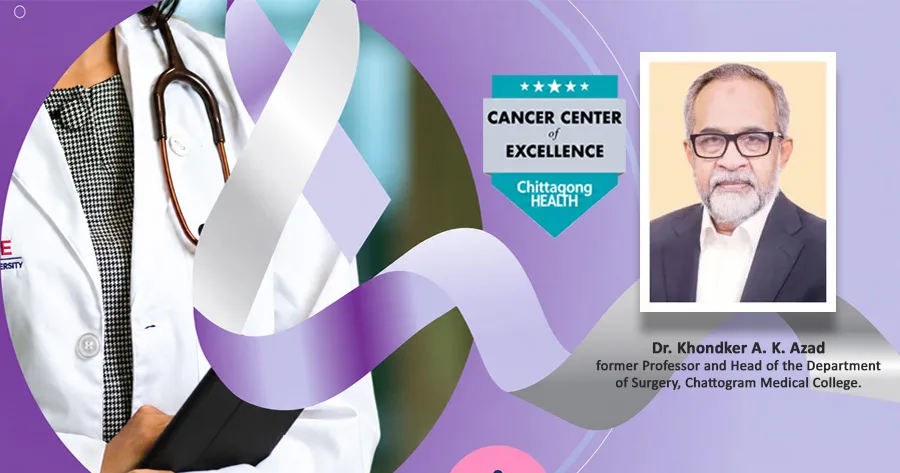
The author is a former Professor and Head of the Department of Surgery, Chattogram Medical College.